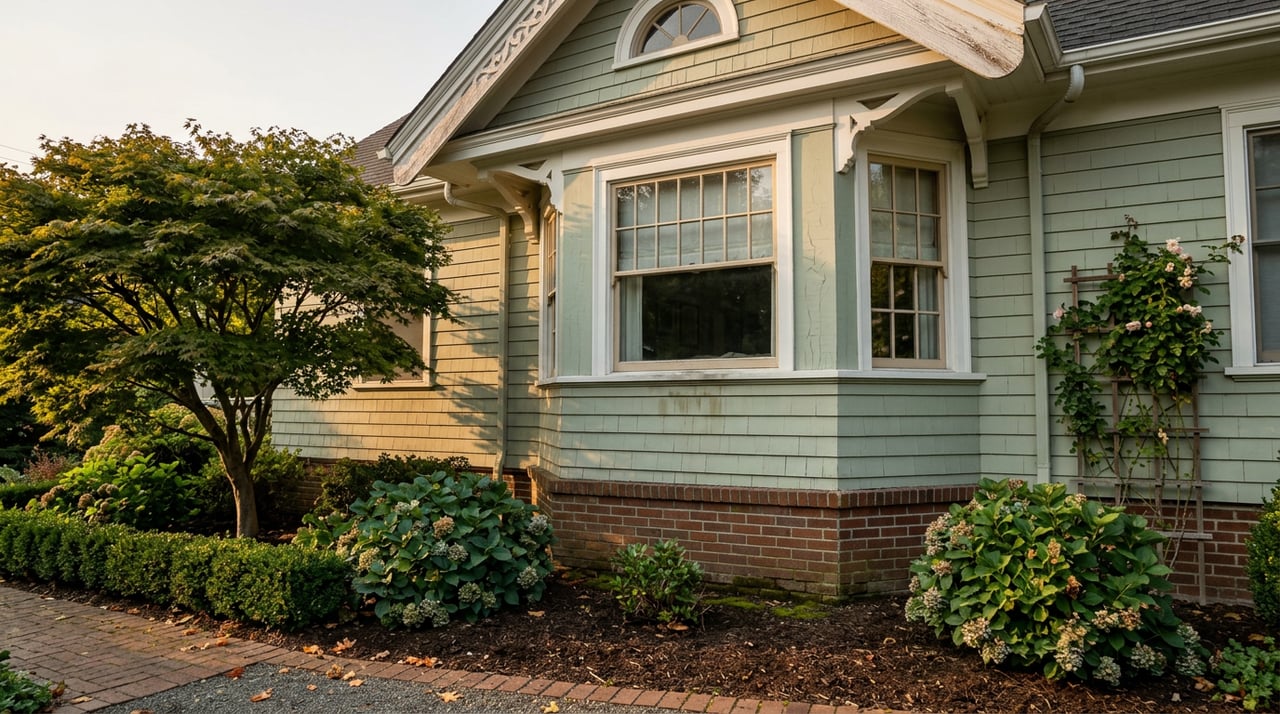
A buyer's agent runs comps on a Gold Coast Queen Anne listed just under $2.2 million. The bones are solid, the facade is original, and the seller's disclosures mention a decade of exterior maintenance done to preservation standards. Somewhere in the due diligence conversation, someone brings up the Mills Act. It is the phrase every Bay Area historic-home buyer eventually hears: sign a contract agreeing to maintain the property, and your county reassesses your taxes using an income approach instead of market value, often cutting the bill by 30 to 60 percent a year. It shows up in Oakland listings. It shows up in San Francisco listings. So the buyer assumes it applies here too.
It doesn't. Not automatically, and for most Gold Coast properties, not at all.
That gap is not a rumor or an oversight in someone's paperwork. It is a jurisdictional fact that changes the real carrying cost of owning one of Alameda's most photographed Victorians, and it rarely surfaces until someone asks the right question at the right time.
Two Governments, One Program
The Mills Act is a state law. California Government Code sections 50280 through 50290 let cities and counties enter into contracts with owners of qualified historic properties, trading a tax reduction for a binding commitment to restore and maintain the building. The state does not run the program. Each local government decides whether to offer it, and if so, how.
Alameda County has a Mills Act program. It's detailed in the county's own Historic Preservation Ordinance and Mills Act Program Guide, both published by the county's Community Development Agency. But read the eligibility language closely and one word does the heavy lifting: unincorporated. The county's Mills Act contracts are available only to properties in unincorporated Alameda County, the pockets of the county that fall outside any city's boundaries, places like Ashland, Cherryland, and San Lorenzo.
The Gold Coast is not unincorporated. It sits squarely inside the City of Alameda, an incorporated municipality with its own government, its own planning department, and its own 1975 Historical Preservation Ordinance, codified as Alameda Municipal Code Section 13-21. That ordinance does real work. It established the process for designating City Monuments, created the Historical Building Study List that identifies the city's inventory of pre-1942 structures, and it directs the city to lean on California's State Historical Building Code, which allows builders and inspectors more flexibility when bringing century-old construction up to modern safety standards without stripping out the details that make a Queen Anne a Queen Anne.
What that 1975 ordinance does not contain, based on the city's own planning department materials, is a Mills Act contract program. Alameda never opted in at the city level.
Who Actually Gets the Deal
This is not unusual as a category of thing. It's unusual in how invisible it is to buyers who are comparing East Bay historic-home markets side by side.
| Jurisdiction | Runs a Mills Act program | Applies to |
|---|---|---|
| City of Oakland | Yes | Qualified historic properties within city limits |
| City and County of San Francisco | Yes | Properties designated under the Planning Code's landmark and historic district provisions |
| Unincorporated Alameda County | Yes | Properties in unincorporated areas only |
| City of Alameda | No established program found | Not applicable to Gold Coast, West End, or any Alameda address |
Oakland runs its own program. San Francisco's Planning Department administers applications with a submission deadline each May. Both are incorporated cities that chose, at some point, to adopt the Mills Act locally. Alameda, sitting in the same county and sharing the same dense concentration of Victorian and Craftsman housing stock, has not made that same choice, at least based on everything the city's planning department currently publishes.
So a buyer comparing a $2.1 million Victorian in Oakland's Adams Point against a $2.1 million Victorian on the Gold Coast is not comparing two properties with identical tax mechanics. One may come with a realistic path to a Mills Act contract. The other, as things currently stand, does not.
What the Missing Incentive Actually Costs
The Mills Act formula values a property based on its income potential rather than its market price, using a capitalized income approach that county guidance says can produce savings in the 30 to 60 percent range depending on the property's value and how recently it was purchased or reassessed. The properties that benefit most are the ones bought or improved recently, which is precisely the profile of a lot of Gold Coast turnover: longtime owners selling to buyers who plan to invest further in restoration.
For a Gold Coast owner, none of that reassessment math is available through the city. The full property tax bill, based on standard assessed value under Proposition 13 rules, is the number that has to be underwritten from day one. There is no ten-year contract to offset years of exterior repainting, roof work, or window restoration with a lower annual bill.
This is the part that rarely makes it into a listing sheet or a median-price conversation. Two historic homes can carry similar purchase prices and wildly different total costs of ownership over a decade, and the difference has nothing to do with square footage or lot size. It comes down to which side of a city boundary the deed sits on.
Why the Gold Coast Still Looks the Way It Does Anyway
None of this means Alameda has ignored its historic housing stock. The 1975 ordinance and the Historical Building Study List give the city a formal way to track and recognize its most significant buildings, and the State Historical Building Code gives owners of pre-1942 structures a genuine tool: the ability to meet code requirements using methods appropriate to historic construction rather than being forced into modern retrofits that would compromise original materials.
That is a meaningful protection. It just is not a tax incentive. A buyer who hears "historic building code" and assumes it functions like the Mills Act is conflating two different tools that happen to live in the same ordinance. One governs how you're allowed to build. The other governs what you pay in property tax. Alameda offers the first. It does not currently offer the second.
The Comparison Worth Running Before You Write an Offer
If you're deciding between a historic property in the Gold Coast and a comparable one in Oakland or Berkeley, the sticker price is only half the underwriting. The other half is whether a Mills Act contract is realistically on the table, because that answer changes the effective annual cost by a wide enough margin to matter over a ten-year hold.
For Gold Coast buyers, the honest starting assumption should be that the historic character of the home, and the cost of maintaining it, rests entirely on the owner's shoulders without that particular state-backed offset. That doesn't make the Gold Coast a worse investment. It makes the math different, and different math deserves to be run before it shows up as a surprise on the first full tax bill after closing.
FAQ
Could a Gold Coast property ever qualify for the county's Mills Act program? Based on current county eligibility rules, no. The county's program is explicitly limited to unincorporated Alameda County. Properties within the City of Alameda's boundaries, including the entire Gold Coast, fall outside that jurisdiction regardless of the home's historic designation.
Could the City of Alameda adopt its own Mills Act program in the future? Any incorporated city can choose to adopt a Mills Act program by ordinance, the way Oakland and San Francisco have. As of now, no such city-level program appears in Alameda's planning department materials. Owners interested in seeing this change would need to raise it with the city's planning department or city council directly.
Is the State Historical Building Code the same thing as a tax break? No. It's a construction standards tool that gives more flexibility in how pre-1942 buildings meet code requirements. It has no bearing on property tax assessment.
Does this affect resale value? It affects carrying cost, not necessarily resale value on its own, since buyers up and down the East Bay are working within the same set of rules. But it does mean a Gold Coast Victorian's total cost of ownership should be modeled without assuming a Mills Act offset, something an out-of-area buyer comparing markets might not think to check.
Historic homes reward the owners who go in with clear eyes about what they're actually paying for, and what they're not getting help with. If you're weighing a Gold Coast Victorian against something in Oakland or Berkeley, or you already own one and want a second opinion on what your next restoration project should look like on paper, the Andrea Ruport Team has spent two decades in these houses and can walk you through what the numbers really mean before you make a move. Let's Make It Happen.