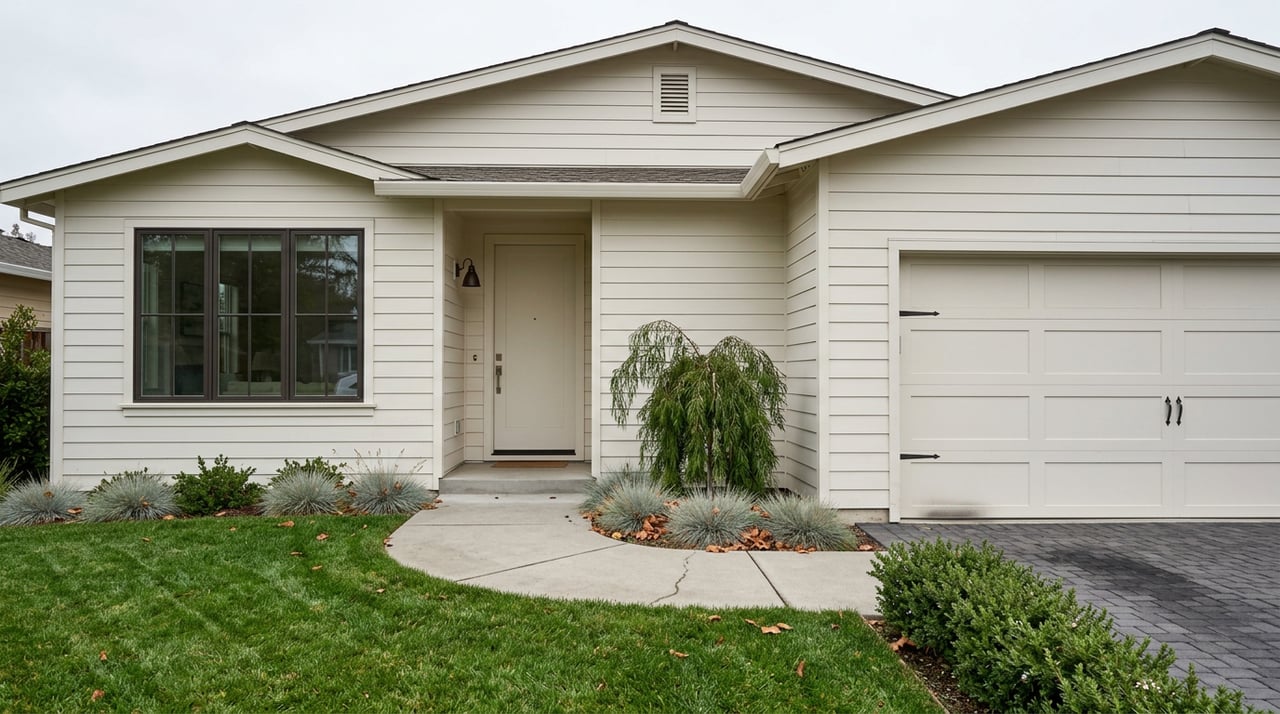
A buyer touring the West End this summer can see two homes in the same afternoon that make the neighborhood's median price feel like a typo. The first is a 1920s bungalow off Central Avenue, original fir floors, a kitchen that still shows its 1970s remodel. The second is a newer townhome in Alameda Landing's Symmetry community, a short drive away, with a rooftop deck and a two-car garage. Both are technically "West End." The number saved on a buyer's phone from a home search app rarely describes either one.
That's not a fluke of two mismatched showings. It's the shape of the market itself. The West End isn't a single housing market wearing one name. It's two, and the blended median that shows up on a listing site is the average of homes that were never competing with each other in the first place.
Two neighborhoods, one zip code
The West End's pre-war streets date back to when the area housed shipyard and Naval Air Station workers, small lots, narrow setbacks, homes built for a workforce, not a waterfront view. That housing stock is what most people picture when they think of the West End: modest, walkable, close to the Webster Street corridor.
Then there's the other West End, the one built after the Naval Air Station closed and the land it left behind got repurposed. Bayport went up in the mid-2000s, roughly 632 single-family homes built around Ruby Bridges Elementary School and Bayport Park, with wider streets and a planned-community feel that has nothing in common with the bungalow blocks a mile away. Alameda Landing came later and is still filling in, anchored by a shopping center with a Target, a Safeway, a Michael's, and an In-N-Out, with new construction from builders like Pulte at Bay 37 and Landsea Homes at Waterside, plus smaller boutique communities like Symmetry still delivering homes.
These aren't two flavors of the same product. One is a century-old housing stock shaped by lot lines drawn before cars were common. The other is a planned development built to 2020s specifications, with three-car garages and open floor plans that didn't exist when the original West End was platted. A median that averages the two isn't describing a market. It's describing a number.
What the numbers actually show when you split them
Here's where the blend becomes visible. As of March 2026, the West End's listed inventory carried a median asking price of about $882,000, a figure that blends everything from condos to century-old cottages to the newer-build product. Isolate just Bayport, though, and the picture changes completely: over the three months ending March 2026, homes there sold at a median of roughly $1.8 million, up about 16 percent from the same period a year earlier.
That's not a typo. It's two different markets sitting inside one neighborhood boundary.
| West End, blended (March 2026) | Bayport, isolated (three months ending March 2026) | |
|---|---|---|
| Reported median | ~$882,000 | ~$1.8 million |
| Year-over-year direction | Roughly flat to citywide trend | Up about 16 percent |
| What it includes | Condos, vintage cottages, new construction | Single-family homes only, one planned community |
The arithmetic only works one way. If the newer-build pocket is trading closer to $1.8 million and the blended neighborhood number is sitting several hundred thousand dollars lower, the rest of the West End's inventory, the condos and the vintage stock, is doing most of the work to pull that median down. The West End's headline price isn't undervaluing anything. It's averaging two markets that were never meant to be compared directly.
Segmenting further into just the neighborhood's newer-construction sales in the first quarter of 2026 sharpens the picture: those homes averaged $1.64 million at roughly $628 per square foot, selling about 13 percent over list in around 17 days, with about two offers per property. That per-square-foot number is worth sitting with. It's lower than what the sticker price alone would suggest, because these are large, three-and-four-bedroom homes. Buyers in this segment aren't paying a premium for scarcity or a walkable Craftsman streetscape. They're paying for square footage and a newer build.
For context, Alameda as a whole sold at a median of about $1.1 million over the three months ending May 2026. The West End's newer-construction slice runs well above that citywide figure. The West End's blended, listed-inventory number runs below it. Both are true. Neither one is "the West End market."
The quarter that proves the point
The clearest evidence that these are two separate markets showed up in a single quarter's volatility. In the fourth quarter of 2025, West End single-family home sales dropped from 18 the prior quarter to just 6, a swing that would normally read as a neighborhood cooling off fast. But four of those six sales were in the newer-build pocket, Bayport and Alameda Landing, averaging just under $1.6 million with about 28 days on market and close to two offers per home.
That means only two of the quarter's six sales came from the vintage side of the neighborhood. A headline number built from six transactions, four of which are a different housing product entirely, tells you almost nothing about what's happening on the bungalow blocks. It tells you that a handful of newer-build closings happened to land in the same three months. The West End's transaction count is small enough that one planned community's closing calendar can swing the entire neighborhood's reported temperature.
This is the trap for anyone reading market data at the neighborhood level rather than the sub-market level. A buyer who sees "West End sales fell 67 percent quarter over quarter" and assumes the whole area is softening is drawing a conclusion the data doesn't support. The vintage market and the new-construction market don't move together, and a small sample size makes it easy to mistake one segment's pause for the whole neighborhood's direction.
What this means if you're actually shopping here
If the West End is on your list, the practical move is to stop asking what "the West End" costs and start asking which West End you're comparing. A few questions worth bringing to any conversation about pricing:
- Is this comp a pre-war home or a Bayport, Alameda Landing, or comparable newer-build property? The two don't share a price-per-square-foot logic, and pricing one against the other will lead to a bad offer in either direction.
- What's the days-on-market pattern for homes actually built in the same era as the one you're touring, not the neighborhood-wide average?
- If a listing agent quotes a neighborhood median as a pricing anchor, ask whether that number includes condos, vintage single-family homes, and new construction all together, or whether it's been segmented.
None of this means one market is a better buy than the other. A vintage cottage and a Bayport four-bedroom serve different buyers with different priorities, character and walkability against space and newer systems. The point is that they're not substitutes for each other, and pricing them as if they were is how buyers end up either overpaying for square footage or underbidding on a home whose value has nothing to do with its size.
FAQ
Is Bayport actually part of the West End, or its own neighborhood? Geographically, yes, Bayport sits within the West End's boundaries on the western side of the island. It's just a planned community built decades after the surrounding vintage housing stock, which is why its pricing and pace don't track the rest of the neighborhood.
Are Bayport and Alameda Landing the same market? Not quite. Bayport was built out in the mid-2000s as a single, largely finished community of roughly 632 single-family homes. Alameda Landing is newer and still delivering product, with a broader mix of condos, townhomes, and single-family homes from multiple builders, plus the retail anchor that Bayport doesn't have.
Does a lower blended median mean vintage West End homes are undervalued? Not on its own. A blended median is an average, not an appraisal. It reflects the mix of what sold, not what any individual home is worth. The way to judge a vintage home's value is against other vintage homes, not against a number that includes an entirely different housing product.
If you're weighing a West End move and want the comps actually sorted by which West End you're looking at, that's the kind of read the Andrea Ruport Team does before a single offer gets written. Let's Make It Happen.